Person in safety gear using equipment inside a large industrial tank, illuminated by beams of light from above.

Magnetic Flux Leakage: Detecting Metal Loss in NDT

Discover the advantages of the magnetic flux leakage testing (MFL) method, understand the basic principles behind MFL, and explore the variety of techniques for applying this method in nondestructive testing across industries.

Photo submitted by Yagil Shoef, M.Sc., Gabi Shoef Ltd., Yavne, Israel

What Is Magnetic Flux Leakage and How Is It Used in NDT?

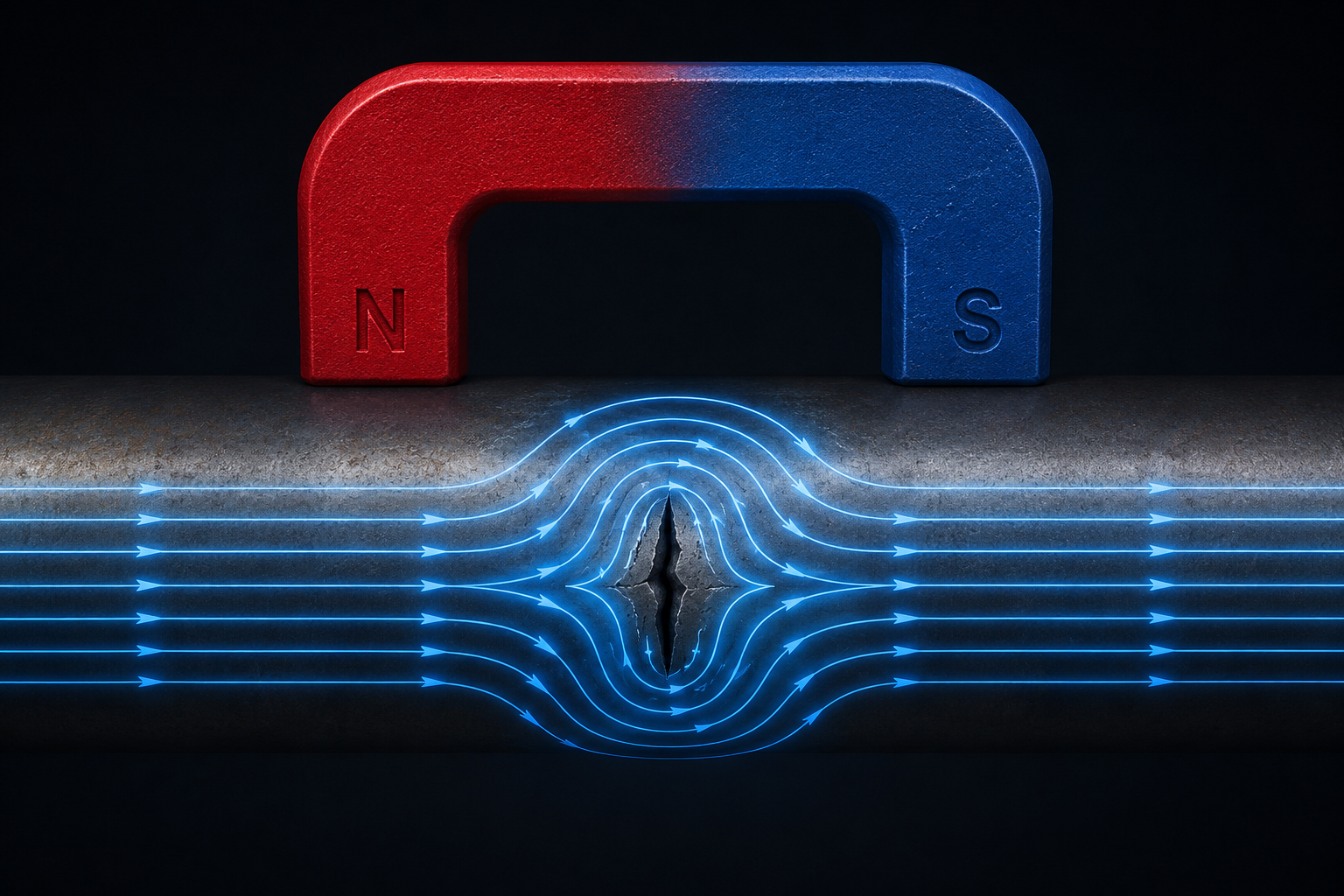
Magnetic flux leakage testing (MFL) is a nondestructive testing (NDT) method used to find corrosion, pitting, and cracks in steel and other materials that can be magnetized (called ferromagnetic materials). MFL works by pushing a strong magnetic field through the material being tested. When the field hits a spot where metal is missing or damaged, the magnetic energy can no longer stay inside the material and “leaks” out at the surface. Sensors detect that leakage and flag it as a potential problem.

What makes MFL especially useful is speed. It can scan large areas quickly—an entire storage tank floor, or miles of pipeline in a single run—making it one of the most efficient methods for finding metal loss in steel structures.

A skilled NDT specialist uses their knowledge of magnetization, sensor behavior, and signal interpretation to set up the test, conduct the scan, and analyze the data to identify areas requiring repair or closer investigation.

The primary objectives of MFL in industrial applications include:

  • Detecting Corrosion and Metal Loss: MFL finds areas where material has thinned due to corrosion, pitting, or erosion, whether on the surface or on the far side of the material from the scanner.

  • Assessing Wall Thickness: By measuring how much magnetic energy leaks out, MFL helps estimate how much metal loss has occurred and whether wall thickness remains within acceptable limits.

  • Covering Large Areas Fast: MFL can scan entire tank floors, long pipeline sections, or large structural plates quickly, making it practical for routine inspection programs that need to cover a lot of ground.

Advantages and Limitations of Magnetic Flux Leakage in NDT

MFL is widely used in oil and gas, petrochemical, and infrastructure industries. Its ability to rapidly scan large surfaces for metal loss makes it a practical choice for high-volume inspection programs. Before selecting MFL, it helps to understand the main advantages and limitations of the method.

Advantages of Magnetic Flux Leakage

  • Fast Coverage: MFL can scan large surfaces quickly, making it practical for inspecting entire tank floors, long pipeline runs, and other high-priority assets within operational timeframes.

  • Detects Surface and Near-Surface Problems: MFL is effective at finding corrosion, pitting, and wall loss on both the side being scanned and the opposite side of the material.

  • Quantitative Results: MFL provides information about the size and extent of metal loss, supporting data-driven maintenance and repair decisions.

  • No Couplant Needed: Unlike ultrasonic testing, MFL does not require a gel or liquid between the sensor and the surface.

  • Works Through Coatings: MFL can often inspect through thin paint or coatings without removing them, reducing preparation time.

  • Portable: MFL equipment ranges from handheld scanners to large robotic systems and pipeline pigs, adapting to a wide range of field conditions.

Limitations of Magnetic Flux Leakage

  • Only Works on Ferromagnetic Materials: MFL requires materials that can be strongly magnetized, such as carbon steel. It cannot be used on aluminum, austenitic stainless steel, or other non-ferromagnetic materials.

  • Surface Condition Matters: Heavy scale, debris, or very thick coatings can interfere with sensor contact and reduce sensitivity.

  • Limited Depth Detection: MFL is most effective when metal loss produces a clear disturbance in the magnetic field. Very deep or subtle defects may produce weaker signals and can be harder to size accurately.

  • Defect Orientation: MFL is most sensitive to defects that interrupt the magnetic field. Narrow defects oriented parallel to the field direction may produce weaker signals.

  • Signal Interpretation: Geometry changes, weld seams, and structural edges can produce signals that resemble defects. Distinguishing true indications from geometric features requires experience.

  • Magnetization Requirements: The material must be magnetized to a sufficient level for reliable detection, so the equipment has to be set up properly for the job.

How Magnetic Flux Leakage Works: Basic Principles

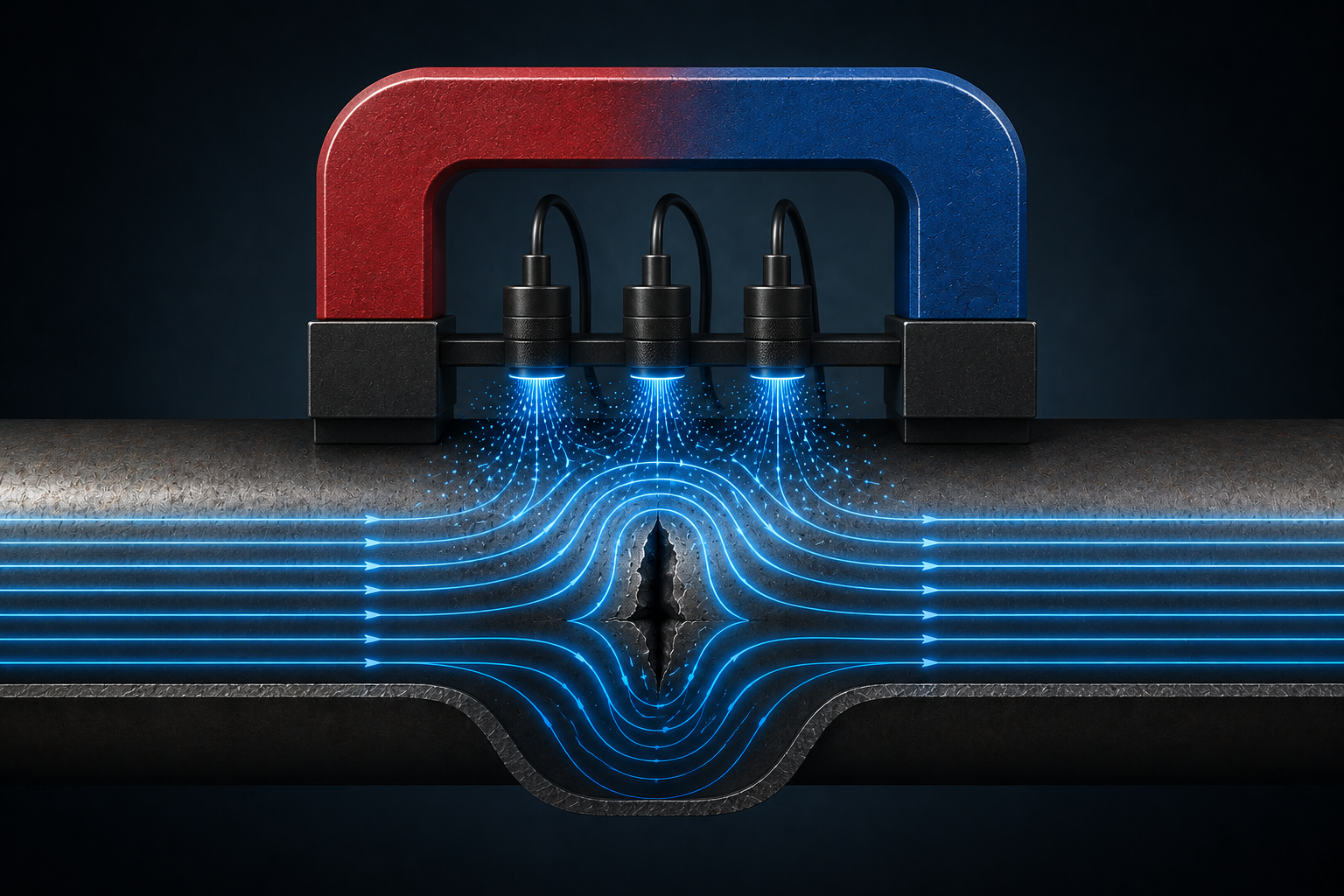
In the MFL method, a strong magnet is used to drive a magnetic field (called magnetic flux) through the steel being tested. When the material is sound and has uniform thickness, the flux travels smoothly through the metal. But when the flux hits a spot where metal is missing—a corrosion pit, a crack, or a thinned area—some of the magnetic energy gets pushed out of the material and leaks into the air above the surface.

Sensors positioned between the magnet poles detect this leakage field. The strength and shape of the leakage signal help show where the metal loss is and how severe it may be.

Think of it like water flowing through a garden hose. If the hose is intact, the water stays inside. If there is a hole, water sprays out. MFL works the same way; the magnetic flux stays inside the steel until it hits a flaw, and then it leaks out where the sensors can detect it.

NDT practitioners use their understanding of magnetization, sensor types, and signal patterns to set up the inspection and interpret what the leakage signals mean.

How Magnetic Flux Behaves in Materials

The behavior of magnetic flux inside the test material is the foundation of MFL. These three concepts explain why the method can detect metal loss from the surface.

Flux Distribution
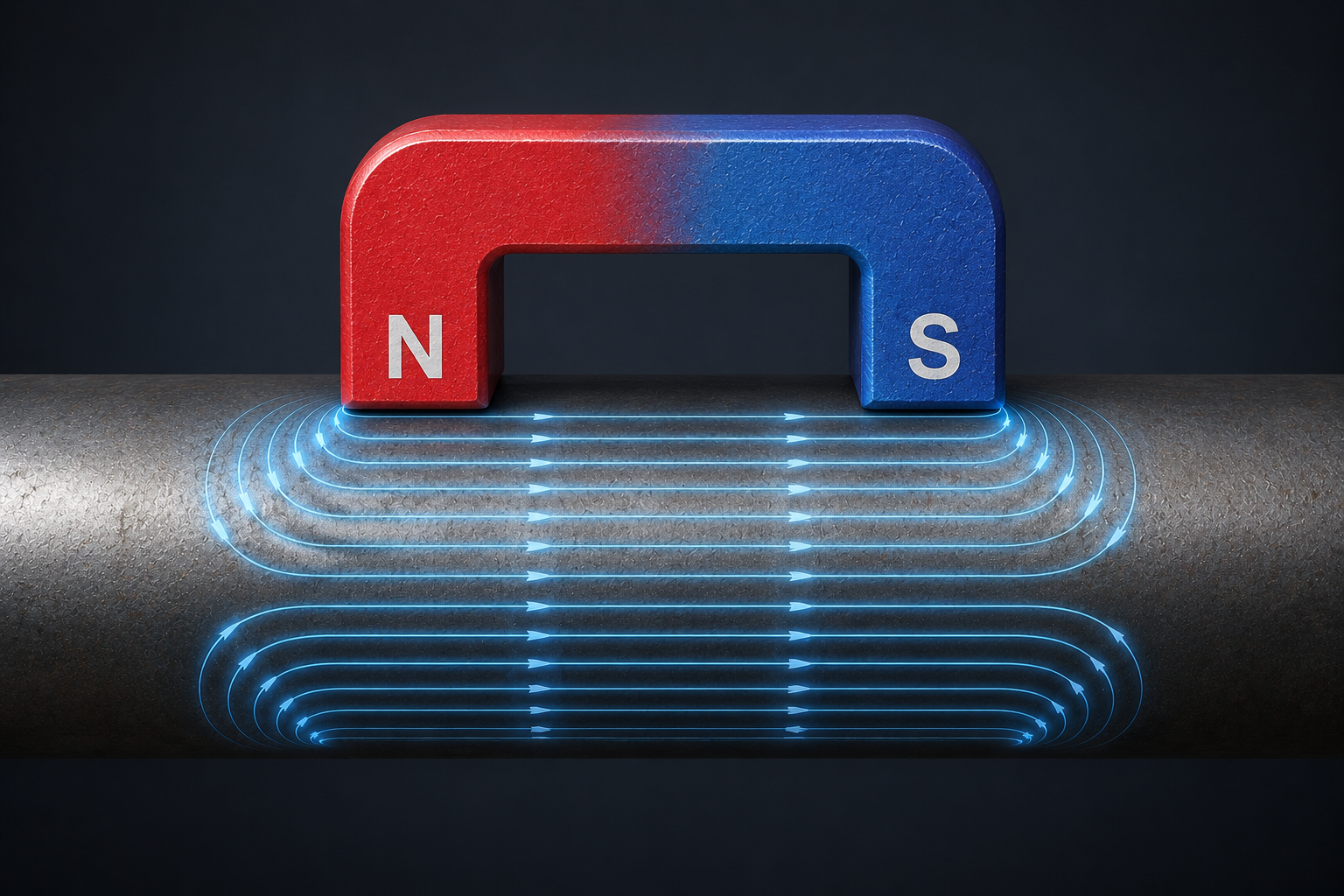
When a strong magnet saturates a piece of steel, the magnetic flux flows through the material in a uniform pattern, like water flowing smoothly through a pipe. This uniform distribution is the baseline. Any disruption to this pattern is what the inspection is looking for.

Flux Leakage

When the flux encounters a spot where metal is missing—a pit, crack, or thinned wall—it cannot follow its normal path through the material. The flux gets pushed out of the surface at the defect site. The stronger the disruption, the more flux leaks out, and the stronger the signal the sensors pick up.

Detection

Sensors placed near the surface detect the leakage field as the scanner moves across the material. The strength and shape of the signal provide information about the location and extent of the metal loss. Different sensor types are used depending on the application and the level of detail required.

How Magnetization Level and Scanner Operation Affect Results

For MFL to work reliably, the material needs to be fully magnetized and the scanner needs to move smoothly and consistently. When either of these is off, the results become harder to read.

  • Full Saturation The magnet needs to be strong enough to push as much flux through the wall as the material can hold. When the material is fully saturated, even small areas of wall loss will cause enough leakage for the sensors to pick up. This is the standard goal for MFL inspection.

  • Under-Saturation If the wall is not magnetized strongly enough, smaller defects may not produce enough leakage to be detected — especially on the far side of the material from the scanner.

  • Scanner Speed The sensors respond to changes in the magnetic field as the scanner moves. If the scanner speeds up, slows down, or vibrates, the signals change too, which can look like a defect when there is not one. Keeping a steady, consistent speed is important for clean data. Most automated systems monitor speed and reduce vibration to help with this.

  • Lift-Off How close the sensor is to the surface matters. The farther away the sensor gets, the weaker the leakage signal becomes. Keeping the sensor at a consistent distance from the surface is essential for reliable, repeatable results.

Three workers in safety gear operate machinery on a high platform, with a clear blue sky and landscape in the background.

How Magnetic Flux Leakage Is Conducted in NDT

MFL uses different equipment setups depending on what is being inspected, how much surface area needs to be covered, and how accessible the inspection surface is.

Manual Scanning

  • Handheld MFL scanners are pushed or pulled across a surface by the technician. This is the standard approach for tank floor inspections, where the scanner moves in a systematic pattern to cover the entire surface. Data is recorded continuously and reviewed after the scan. Manual systems are well suited to confined spaces, irregular layouts, and inspections where setup time needs to be minimized.

Automated and Robotic Scanning

  • Motorized scanners move across large surfaces automatically at controlled speed, providing consistent coverage and reliable signal quality. These are commonly used for large tank floors and structural plate inspections.

  • Robotic crawlers extend this capability to vertical surfaces, underwater structures, and other locations where manual scanning would be impractical or unsafe. Automated systems can also flag signals that may indicate areas needing closer review.

In-Line Pipeline Inspection (Pigging)

  • MFL pipeline pigs are inspection tools that travel inside a pipeline, propelled by the flow of product. As the pig moves, its magnets saturate the pipe wall and sensors inspect the full circumference for corrosion, pitting, and mechanical damage.

  • High-resolution pigs use denser sensor arrays and stronger magnets to detect smaller defects and provide more detailed data for fitness-for-service assessments.

Advanced MFL Technique

Metal Magnetic Memory (MMM)

  • A passive technique that detects residual magnetic fields in ferromagnetic materials without requiring external magnetization equipment.

  • Measures stress concentration zones and early-stage damage by reading the magnetic field patterns that develop naturally in metal components under mechanical load.

  • Useful as a screening tool for identifying areas of concern that may need follow-up inspection with conventional MFL or other NDT methods.

Add Magnetic Flux Leakage Certification to Your Qualifications

ASNT certifications enable you to become a qualified Level III in MFL.

What Certification Is Right for Me?

Industry Applications of Magnetic Flux Leakage

MFL is used wherever large areas of steel need to be inspected for metal loss quickly and reliably. Its speed and sensitivity make it a standard tool in several high-value inspection programs.

Energy

In oil, gas, and petrochemical facilities, MFL is used extensively to inspect pipelines, storage tank floors, and pressure vessels for corrosion, pitting, and wall loss. In-line MFL pigs are the primary method for assessing the condition of long-distance transmission pipelines.

Learn How NDT Is Used in Energy

"A composite image showcasing various energy sources: solar panels in the foreground, oil pump jacks in the middle ground, and wind turbines and a power plant in the background. The scene illustrates the diversity of energy production methods at sunset.

Aerospace

MFL has limited application in aerospace, but it is used to inspect ferromagnetic components like landing gear and wheels for cracks and corrosion that could affect safety and performance.

Learn How NDT Is Used in Aerospace
A technician performing maintenance or inspection work on the landing gear of a large commercial airplane inside an aircraft hangar. The scene is illuminated with a blue tint, highlighting the aircraft's engines and the structural details of the hangar.

Transportation

In transportation, MFL is used to inspect rail tracks for surface-breaking cracks and head wear, ship hulls for corrosion, and steel structural components in vehicles and infrastructure.

Learn How NDT Is Used in Transportation
A modern high-speed train moving swiftly through a train station at sunset. The motion blur effect emphasizes the train's speed, with vibrant colors in the sky and station lights creating a dynamic and futuristic atmosphere.

Manufacturing

MFL is used in steel manufacturing for quality control of plates, pipes, rods, and welded assemblies. It provides fast screening to ensure products are free from significant metal loss or defects before they ship.

Learn How NDT Is Used in Manufacturing

A modern manufacturing facility with robotic arms working on an automated assembly line. The scene is well-lit with blue overhead lighting, showcasing advanced machinery and precision engineering in a clean, industrial environment.

Infrastructure

MFL is used to inspect steel bridges, storage tanks, and buried pipelines for corrosion and cracking. It supports long-term maintenance programs by identifying areas of concern before they become safety hazards.

Learn How NDT Is Used in Infrastructure
A large infrastructure project featuring a highway under construction. Several cranes are positioned along the unfinished sections of the elevated roadway and bridge. The scene is set on a clear, sunny day with blue skies and some scattered clouds.

Example: MFL in the Real World

In petrochemical plants, MFL is used routinely to inspect the floors of aboveground storage tanks. These large flat-bottomed tanks hold crude oil, refined products, or chemicals, and their floors are susceptible to corrosion from both the product side and the soil side.

During a routine inspection, a technician pushes an MFL scanner across the tank floor in a systematic pattern. The scanner's yoke saturates the steel, and sensors in the gap between the poles detect leakage signals indicating metal loss—whether that loss is on the product side, the soil side, or both. The data is recorded continuously and reviewed after the scan to identify areas that require repair or further evaluation.

A worker in protective gear operates a machine inside a dimly lit tank, casting a shadow on the wall near a bright light source.

Deeper Learning About Magnetic Flux Leakage

ASNT offers both members and nonmembers learning opportunities and resources for NDT specialists certified in MFL.

Book

The MFL Compendium: Articles on Magnetic Flux Leakage

The MFL Compendium: Articles on Magnetic Flux Leakage is a compilation of technical articles on magnetic flux leakage (MFL) drawn from ASNT’s monthly journal Materials Evaluation. The content offers real-world and laboratory-tested insight into the field of MFL. Students will find this publication to be an invaluable tool toward building an understanding of MFL while the seasoned technician will find the guide to be a useful reference document. The Compendium is one of the references used in the development of the ASNT NDT Level III examination for magnetic flux leakage and it is also cited as a training reference in the 2011 edition of ANSI/ASNT American National Standard CP-105.

Book

ASNT Questions & Answers Book: Magnetic Flux Leakage Testing (MFL)

This Questions & Answers Book is an excellent resource for preparing for MFL examinations. Developed by ASNT’s MFL Committee, this book features Level I, II, and III review questions.

Research Paper

The Use of Magnetic Flux Leakage Testing Method and Apparatus for Steel Pipe

Steel pipes are important to the oil and gas industry, and an accurate and fast nondestructive testing technique is necessary to monitor their condition. The technology described in this paper can automate testing on coiled tubing quickly and accurately.

Chat Window Trigger