Worker in safety gear inspects a wind turbine blade with measuring tools and markings, under a clear blue sky.

Microwave Testing: Inspecting Non-Metal Materials with NDT

Discover the advantages of the microwave testing (MW) method, understand the basic principles of MW, and explore the variety of techniques for applying microwave testing in nondestructive testing across industries.

What Is Microwave Testing and How Is It Used in NDT?

Microwave testing (MW) is a nondestructive testing (NDT) method that uses electromagnetic waves in the microwave frequency range to inspect non-metallic materials such as composites, plastics, ceramics, and rubber. Microwaves can pass through these materials and interact with their internal structure, revealing hidden defects, moisture, and thickness variations.

MW works by sending microwave signals into or through a material and analyzing what comes back. When a signal encounters a defect, a change in material properties, or a layer boundary, part of the signal is reflected back to the probe. Changes in the signal help indicate differences within the material.

What makes MW especially useful is that it works without touching the material and does not require a coupling fluid. This makes it practical for inspecting large surfaces quickly and for applications where contact is difficult or undesirable.

A skilled NDT specialist uses their knowledge of microwave behavior, probe selection, and signal analysis to configure the test, conduct the inspection, and interpret the data correctly.

The primary objectives of MW in industrial applications include:

  • Detecting Internal Defects: MW can help identify internal discontinuities, layer separations, and other changes in nonmetallic materials without cutting or disassembling the component.

  • Measuring Thickness: MW can be used to estimate the thickness of coatings, layers, and some components by analyzing how microwave signals interact with the material.

  • Assessing Moisture Content: Microwaves are strongly affected by the presence of water. MW testing can detect and estimate moisture in materials such as composites, insulation, and building materials.

Advantages and Limitations of Microwave Testing in NDT

MW is used in industries including aerospace, manufacturing, energy, and infrastructure. Its ability to inspect non-metallic materials without contact makes it a useful complement to other NDT methods. Before selecting MW, it helps to understand the main advantages and limitations.

Advantages of Microwave Testing

  • Non-Contact Inspection: MW does not need to touch the material being tested. This makes it practical for inspecting moving objects, delicate surfaces, and components in production environments.

  • No Couplant Required: Unlike ultrasonic testing, MW does not need a gel or liquid between the probe and the material, simplifying setup and cleanup.

  • Inspects Non-Metallic Materials: MW is especially useful for many nonmetallic materials like composites, plastics, ceramics, and rubber—materials that are difficult to inspect with methods designed for metals.

  • Sensitive to Moisture: MW is highly effective at detecting and measuring moisture in materials, which is important for quality control and structural assessment of insulation, composites, and building materials.

  • High Resolution: At higher frequencies, MW can provide finer detail in some imaging applications, helping reveal layer boundaries and other changes within the material.

  • Minimal Surface Preparation: MW typically requires little or no surface preparation, saving time during inspection setup.

Limitations of Microwave Testing

  • Does Not Penetrate Metals Well: In conductive materials, microwaves do not penetrate deeply, so MW is generally limited to surface inspection rather than internal inspection.

  • Interpretation Requires Training: MW data can be complex. Understanding what the signals mean and distinguishing defects from normal material variation requires specialized training and experience.

  • Affected by Environment: Results can be influenced by factors such as material properties, temperature, geometry, and attenuation.

  • Equipment Cost: MW systems, particularly those operating at higher frequencies for detailed imaging, can be expensive.

  • Specialized Training: MW signals can be complex, so operators need training in microwave behavior, probe selection, and data interpretation for the materials being inspected.

How Microwave Testing Works: Basic Principles

In MW, a probe transmits microwave signals into the material being inspected. These signals travel through the material and interact with its internal structure. When a signal encounters a boundary (between two layers, around a void, or at a moisture pocket), part of the energy is reflected back to the probe.

The system analyzes changes in the signal, including its strength and phase, to identify differences in the material. Locations where the signal differs from the baseline indicate a change in the material—a defect, a layer boundary, or a variation in moisture or composition.

NDT practitioners use their understanding of microwave behavior, probe selection, and material properties to configure the test, conduct the scan, and correctly interpret the data.

How Microwaves Interact with Materials

Microwaves are part of the electromagnetic spectrum, sitting between radio waves and infrared light. Their behavior in non-metallic materials depends on a few key properties.

Attenuation

Like sound fading over distance, microwave signals weaken as they travel through material. Some materials let signals pass easily, while others absorb energy quickly, limiting how deep the inspection can reach.

Reflection

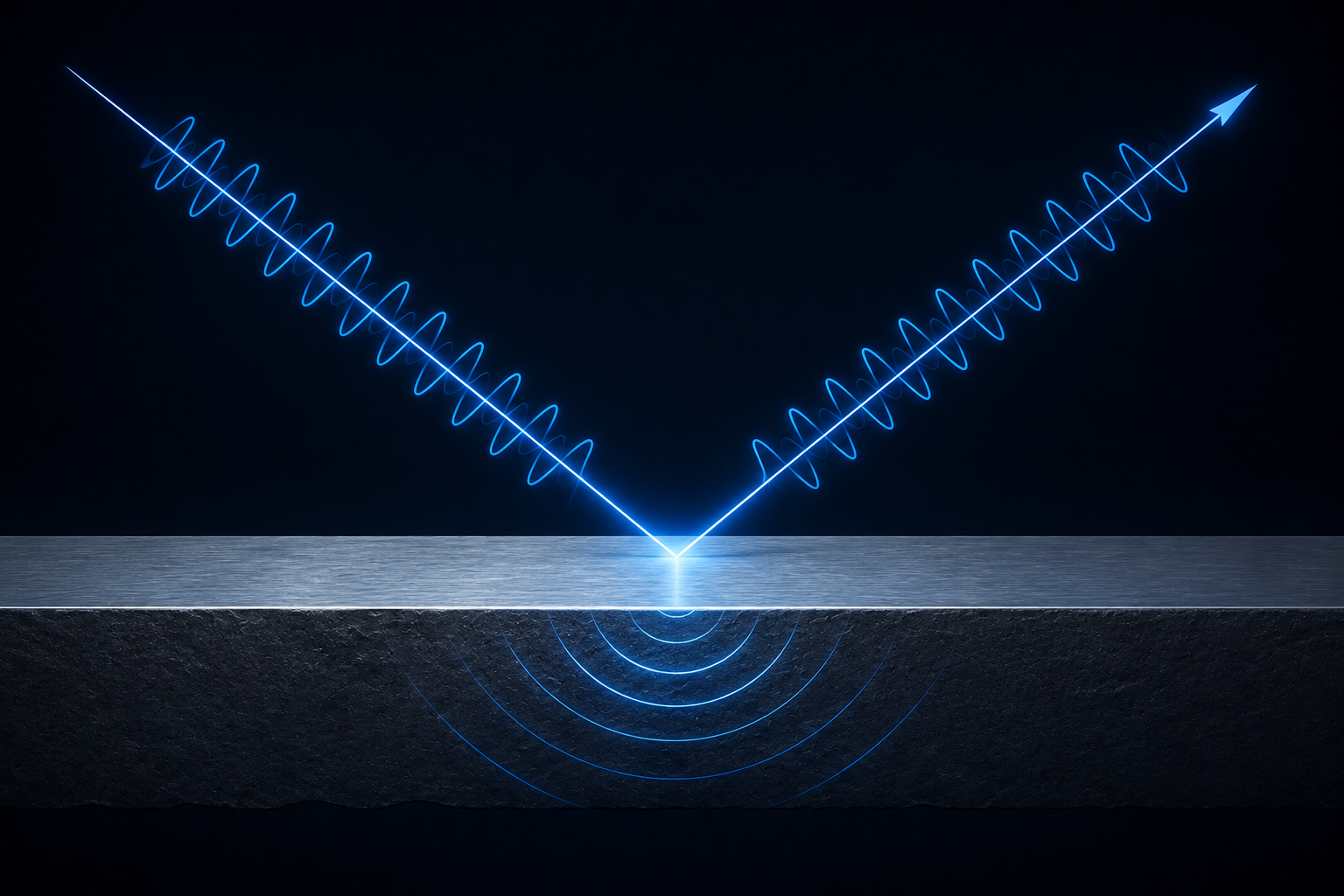
Similar to light bouncing off a mirror, microwaves reflect when they hit a boundary between different materials. Defects and layer changes produce reflections the system detects.

Transmission

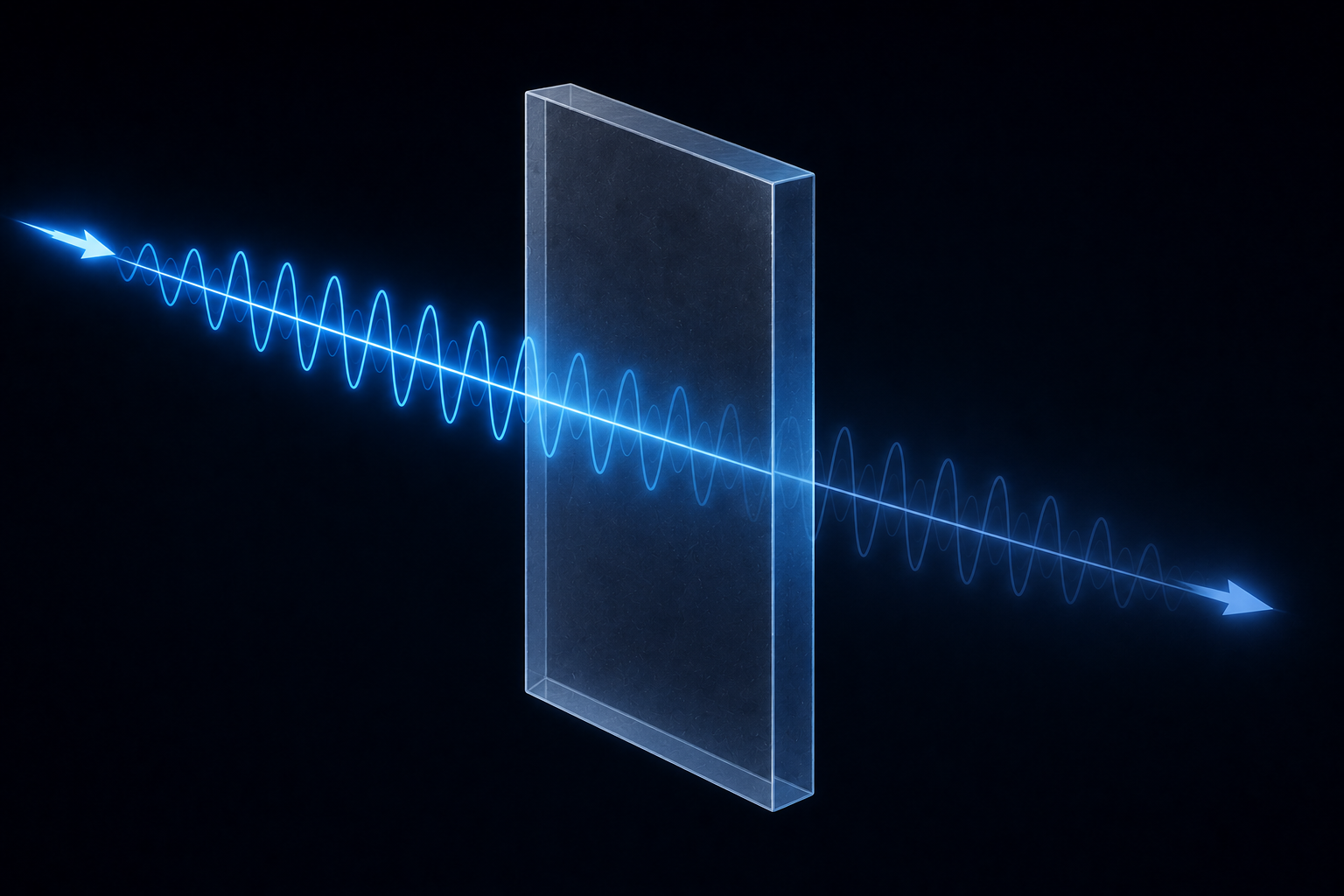
Like light passing through a window, a portion of the signal continues through the material. Measuring what comes through the other side reveals changes in thickness, density, or composition.

How Frequency Affects Results

Microwave testing uses a wide frequency range, and the frequency selected affects how the signal interacts with the material and what kinds of changes can be detected.

Lower frequencies penetrate deeper into the material but produce less detailed images. They are useful for thick composites, concrete, and applications where depth of penetration is the priority.

Higher frequencies produce higher-resolution images but do not penetrate as deep. They are used for thin layers, coatings, and applications where fine detail is needed.

A person operates a handheld microwave testing device on a large pipe surface, wearing protective gloves and a jacket.

How Microwave Testing Is Conducted in NDT

MW uses different probe setups and inspection approaches depending on the material, the type of defect being sought, and whether contact with the surface is possible.

Contact and Near-Field Inspection

  • Open-ended waveguide probes are placed on or very close to the material surface. They send and receive microwave signals directly into the material, providing high sensitivity for near-surface features.

  • Near-field techniques can be used for localized inspection of specific areas where finer spatial detail is needed.

Non-Contact and Free-Space Inspection

  • Free-space testing transmits microwaves through the air to the material without any contact. This approach is practical for inspecting large surfaces quickly, moving objects on a production line, or areas where physical contact is not possible.

  • Standoff inspection positions the probe at a fixed distance from the surface, balancing resolution and coverage for scanning applications.

Imaging

  • Microwave imaging scans across a material to build a map showing changes within the material, such as layer boundaries, moisture variation, or other differences in dielectric properties.

  • Synthetic-focused imaging methods combine data from multiple probe positions to improve the resulting image.

Industry Applications of Microwave Testing

MW is used wherever non-metallic materials need to be inspected for hidden defects, moisture, or thickness variations. Its non-contact capability and sensitivity to material properties make it a useful tool in several specialized inspection programs.

Energy

In the energy sector, MW is used to inspect composite materials in wind turbine blades, non-metallic pipeline coatings and linings, and insulation systems for moisture ingression and material degradation.

Learn How NDT Is Used in Energy
"A composite image showcasing various energy sources: solar panels in the foreground, oil pump jacks in the middle ground, and wind turbines and a power plant in the background. The scene illustrates the diversity of energy production methods at sunset.

Aerospace

MW inspects composite structures used in aircraft, including radomes (the nose cones that protect radar systems), control surfaces, and fuselage panels. Its ability to detect delaminations, moisture, and core damage in composite materials makes it a useful complement to other NDT methods.

Learn How NDT Is Used in Aerospace
A technician performing maintenance or inspection work on the landing gear of a large commercial airplane inside an aircraft hangar. The scene is illuminated with a blue tint, highlighting the aircraft's engines and the structural details of the hangar.

Transportation

MW is used to inspect non-metallic components in vehicles and rail systems, including fiberglass and composite body panels, insulation materials, and non-metallic pipeline linings in underground transit infrastructure.

Learn How NDT Is Used in Transportation
A modern high-speed train moving swiftly through a train station at sunset. The motion blur effect emphasizes the train's speed, with vibrant colors in the sky and station lights creating a dynamic and futuristic atmosphere.

Manufacturing

In manufacturing, MW provides quality control for plastics, ceramics, composites, and rubber products. It is used to verify layer thickness, detect voids and inclusions, and assess moisture content in materials during and after production.

Learn How NDT Is Used in Manufacturing
A modern manufacturing facility with robotic arms working on an automated assembly line. The scene is well-lit with blue overhead lighting, showcasing advanced machinery and precision engineering in a clean, industrial environment.

Infrastructure

MW is used to inspect non-metallic structures like composite wraps on pipelines, concrete coatings, and building materials for hidden defects and moisture. It is also applied to heritage structures where non-invasive assessment is required.

Learn How NDT Is Used in Infrastructure
A large infrastructure project featuring a highway under construction. Several cranes are positioned along the unfinished sections of the elevated roadway and bridge. The scene is set on a clear, sunny day with blue skies and some scattered clouds.

Example: MW in the Real World

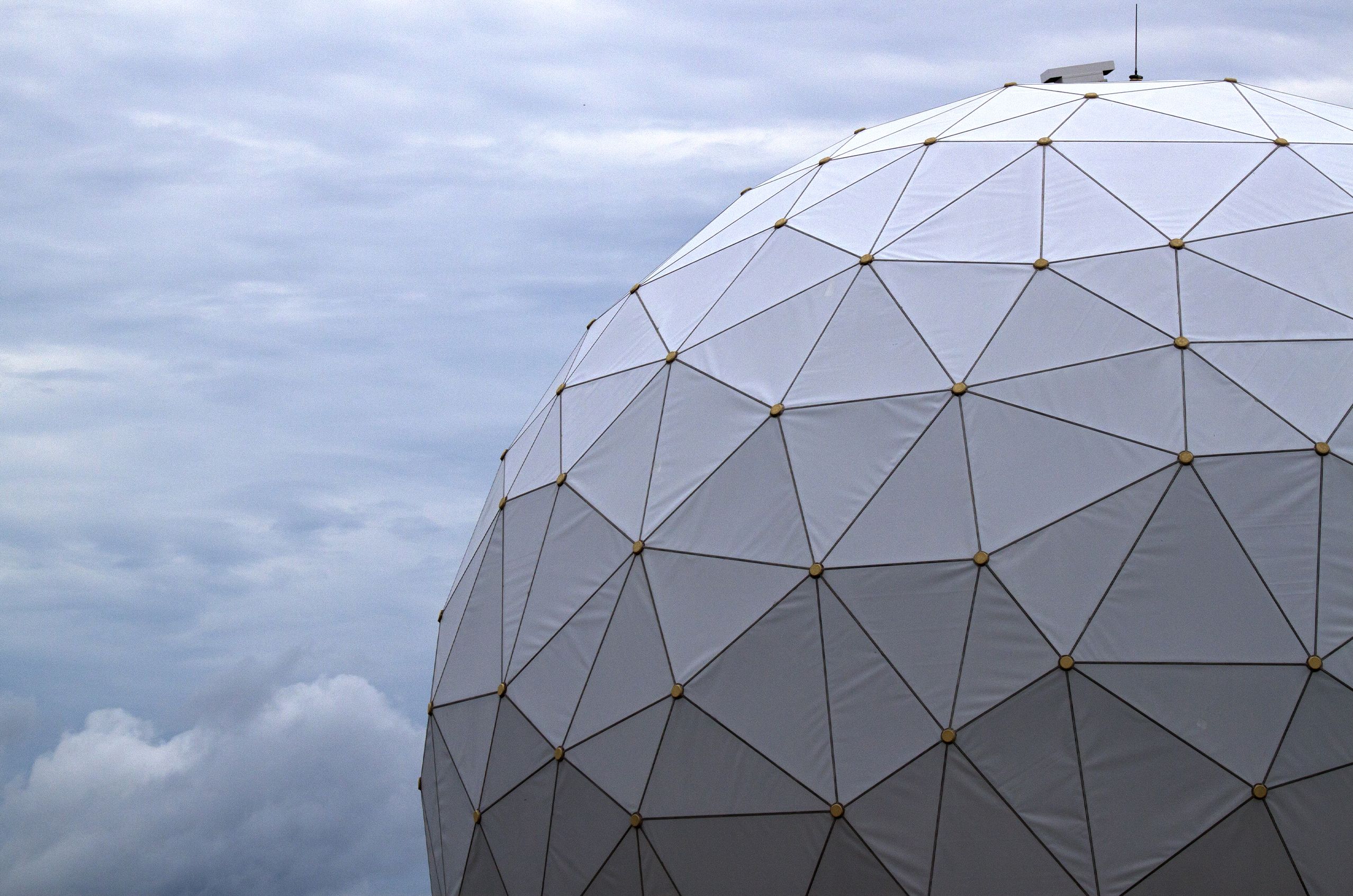
In the aerospace industry, radomes—the protective covers over aircraft radar systems—are made from composite materials that must be transparent to radar signals. Any defect in the composite structure can degrade radar performance or compromise the structural integrity of the radome.

MW testing is used to inspect radomes during manufacturing and maintenance because it can see inside the composite structure without disassembly or contact. The MW probe scans across the surface, and variations in the reflected signal reveal voids, delaminations, and moisture pockets that are not visible on the outside.

This is a clear example of how MW fills a niche that other NDT methods cannot easily address: inspecting non-metallic materials for internal defects without contact, couplant, or disassembly.

A radome, a geodesic dome with triangular panels, against a cloudy sky background, featuring a white surface and gold nodes.

Deeper Learning About Microwave Testing

ASNT offers both members and nonmembers learning opportunities and resources for NDT specialists certified in MW.

Book

The MW Compendium: Articles on Microwaves

A curated collection of technical papers on Microwave Testing published across ASNT journals from 1963 to 2021. Covers defect detection, material properties, corrosion, crack detection, and signal processing. Serves as a key reference for the MW body of knowledge and Level III exam development.

Book

ASNT Level III Study Guide: Basic, 5th ed.

Prepare for the ASNT NDT Level III Basic examination using this comprehensive study guide designed for both ASNT certification candidates and those pursuing Basic Level III exams under employer-based programs. The content and sample questions have been updated to align with the 2024 editions of SNT-TC-1A, CP-189, and CP-105. Included are inquiries and responses from ASNT’s SNT-TC-1A Interpretation Panel for in-depth understanding.

An extensive section is devoted to the general application of 11 different NDT methods, including topical outlines from the 2024 edition of CP-105, references, and method-specific questions and answers. Entire sections from both SNT-TC-1A and CP-189 are provided for convenient reference.

Section III presents questions that follow the second edition of ASNT’s Materials and Processes for NDT Technology, supporting a logical and efficient study experience.

Additional resources include the Code of Ethics for Level III NDT Personnel Certified by ASNT, an overview of the ASNT NDT Level III Program, and handy tables of common units used in NDT, all conveniently located in the appendixes.

This study guide is an essential resource for anyone seeking a thorough and up-to-date preparation for the ASNT Level III Basic examination.

Research Paper

Microwave and Millimeter Wave Nondestructive Testing Principles

The nondestructive testing (NDT) toolbox is made up of a number of standard and commonly used techniques and methods, including electromagnetic testing, ultrasonic testing, magnetic particle testing, radiographic testing, acoustic emission testing, and liquid penetrant testing. Each technique/method possesses its own unique physics-or applications-based limitations while providing certain specific advanta-geous and desirable features. Microwave and millimeter waves occupy the frequency spectrum covering ~300 MHz to 30 GHz and 30 to 300 GHz, corresponding to wavelengths (in air) of 1000 to 1 mm (39 to 0.04 in.), respectively. Materials interact with these waves in ways that make them extremely useful for certain NDT applications (Kharkovsky and Zoughi 2007; Case and Kenderian 2017). Much has taken place in advancing microwave and millimeter wave techniques over the past three decades (Zoughi 1995). The unique features and capabilities offered by these NDT techniques, along with the sustained research and development efforts in this area, have brought microwave testing (MW) to its rightful place in the NDT toolbox as a viable, recognized method (Case and Kenderian 2017).

Chat Window Trigger